
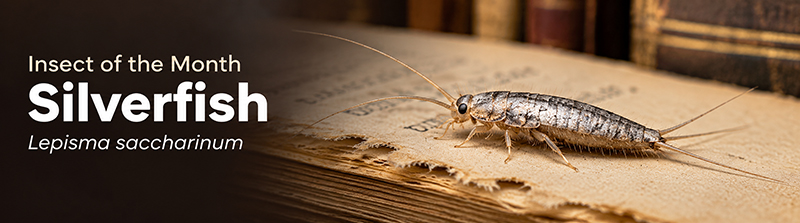
Insect of the Month: Silverfish (Lepisma saccharinum)
Silverfish might be small, but they can cause some serious damage when left unchecked. These fast-moving, silvery insects are a common pest in Australian homes, offices, libraries, storage facilities and commercial buildings. While they don’t bite or pose a significant direct health risk, their appetite for paper, fabrics, adhesives and other starch-rich materials can make them a costly nuisance.
For professional pest managers, silverfish infestations can be tricky. They’re nocturnal, excellent at hiding and capable of surviving for long periods in concealed areas. Understanding their behaviour, preferred environments and feeding habits is the key to getting on top of an infestation.
What are silverfish?
The common silverfish (Lepisma saccharinum) is a primitive, wingless insect belonging to the order Zygentoma. Silverfish have been around for hundreds of millions of years, making them one of the oldest surviving insect lineages.
They’re easily recognised by their flattened, carrot-shaped bodies, metallic silver-grey scales and distinctive wriggling movement that resembles a swimming fish.
Adult silverfish typically grow to around 10–13 mm long, with two long antennae at the head and three tail-like appendages at the rear.
Unlike many household insects, silverfish don’t undergo complete metamorphosis. Young silverfish look much like miniature adults, gradually developing their characteristic silvery scales as they mature.
Where are silverfish commonly found?
Silverfish prefer dark, sheltered environments, particularly those with elevated humidity. In Australian properties, technicians commonly encounter them in bathrooms, laundries, kitchens, roof voids, cupboards, storage rooms and behind skirting boards.
Commercial environments can also provide ideal conditions, especially where paper products, cardboard packaging or archived documents are stored for extended periods.
Common harbourage areas include:
- Behind wallpaper, skirting boards and wall linings.
- Inside cupboards, wardrobes and storage cabinets.
- Around plumbing penetrations and damp building materials.
- In cardboard boxes, bookshelves and document storage areas.
- Beneath flooring and inside cracks or expansion joints.
Although silverfish generally favour humid environments, some related species, including the long-tailed silverfish (Ctenolepisma longicaudatum), can tolerate drier conditions. Correct species identification can therefore make a difference when developing a treatment strategy.
What do silverfish eat?
Silverfish have a particular liking for carbohydrates, especially starches and certain sugars. Unfortunately, this means plenty of everyday materials found in homes and commercial premises are on the menu.
Their feeding activity can damage books, wallpaper, paper documents, cardboard packaging, bookbinding adhesives, photographs and some natural-fibre textiles.
In libraries, museums and archival facilities, silverfish are considered an important pest because even relatively small populations can cause irreversible damage to valuable collections.
Signs of silverfish activity include irregular holes in paper, scraped surfaces, damaged wallpaper, yellowish staining, shed scales and small dark droppings.
One of the challenges for pest managers is that visible damage may occur some distance from the insects’ primary harbourage areas.
Understanding the silverfish life cycle
Silverfish develop gradually through three main stages: egg, nymph and adult.
Females deposit small, pale eggs in protected cracks and crevices. Depending on temperature and environmental conditions, eggs may hatch within several weeks.
The emerging nymphs resemble smaller versions of adults and undergo repeated moults as they grow. Unlike most insects, silverfish can continue moulting even after reaching adulthood.
Development rates vary considerably with species, temperature, humidity and food availability. Adults can live for several years under favourable conditions.
This relatively long lifespan, combined with their ability to remain concealed, means an established infestation can persist without attracting much attention.
How to manage silverfish infestations
For pest managers, successful silverfish control starts with identifying the conditions allowing the insects to survive.
1. Inspect potential harbourage areas
Look beyond the areas where silverfish have been sighted. Check wall cavities, skirting boards, cupboards, storage areas, plumbing penetrations and other concealed spaces. Sticky monitoring traps can help identify activity hotspots and track treatment effectiveness.
2. Address moisture problems
Reducing excessive humidity can make an environment less favourable for moisture-dependent silverfish. Leaking pipes, poor ventilation, condensation and damp building materials should all be investigated.
3. Reduce food sources and clutter
Stored cardboard, paper products and unnecessary packaging provide both food and shelter. Recommend improved housekeeping, regular vacuuming and suitable sealed storage for vulnerable materials.
4. Apply targeted treatments
Where chemical control is required, select an APVMA-registered product with label directions appropriate to the pest, application method and treatment site. Target cracks, crevices and identified harbourage areas in accordance with the product label.
Avoid indiscriminate spraying, particularly around sensitive documents, food-handling areas or valuable collections.
5. Monitor and follow up
Silverfish can remain hidden for extended periods. Follow-up inspections and monitoring are important for assessing treatment effectiveness and identifying any remaining harbourage areas.
For commercial clients, an integrated pest management approach combining inspection, environmental management, targeted treatments and ongoing monitoring will generally provide the most sustainable results.
Did you know?
Silverfish can survive for extended periods without feeding when environmental conditions are favourable. They’re also capable of digesting cellulose-rich materials, helping explain why paper, books and cardboard can become attractive food sources.
And despite their name, silverfish aren’t fish at all. Their name comes from their metallic scales and distinctive fish-like movement.
The bottom line for pest managers
Silverfish might not attract the same attention as cockroaches, termites or rodents, but they can still create expensive problems for residential and commercial clients.
The biggest challenge is often locating the source of activity rather than simply treating the insects that are visible.
A thorough inspection, correct identification and a treatment program addressing both harbourage and environmental conditions will go a long way towards achieving lasting control.
For professional pest control products, application equipment and technical advice, contact your local Agserv branch.