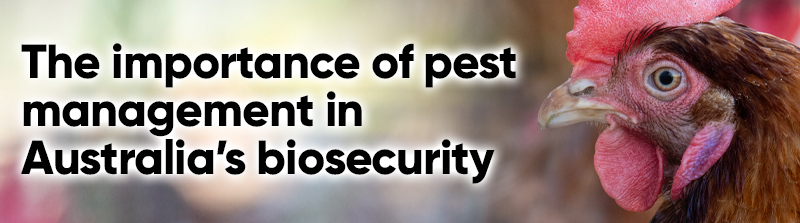
Bird flu reinforces the importance of professional pest management in Australia’s biosecurity system
(original article published by Australian Environmental Pest Managers Association (AEPMA) 28 July 2026)
The Australian Environmental Pest Managers Association (AEPMA) is calling for bird and rodent management to be recognised as a critical component of Australia’s response to Highly Pathogenic Avian Influenza (H5 bird flu).
Recent detections of the globally circulating H5 strain in wild birds across Australia highlight the ongoing threat posed by the virus. While there have been no detections in Australia’s commercial poultry industry, experience overseas has shown that preventing contact between infected wildlife and poultry remains the strongest defence against outbreaks.
Australia’s poultry industry contributes more than $3.8 billion annually to the national economy and supports thousands of jobs across regional Australia. Protecting the industry requires more than movement controls and surveillance. It also requires effective pest management.
An overlooked part of biosecurity
Wild birds are recognised as the primary carriers of avian influenza. Limiting their access to poultry sheds, feed storage and water sources is one of the most effective ways to reduce the risk of disease entering commercial operations.
Professional pest managers play a significant role by:
- installing bird-proofing systems and exclusion netting
- managing pest bird populations around poultry facilities
- protecting feed and water sources from contamination
- identifying structural weaknesses that allow wildlife access
- implementing ongoing monitoring and integrated pest management programs.
These preventative measures reduce opportunities for disease transmission and strengthen on-farm biosecurity.
Rodents should not be overlooked
Rodents are another important consideration.
Brown rats, black rats and house mice commonly move between the surrounding environment, feed stores and poultry sheds. International research has demonstrated that these species are susceptible to H5 avian influenza viruses and may shed the virus without obvious signs of illness.
Although rodent-to-poultry transmission has not been conclusively demonstrated, rodents are capable of scavenging infected bird carcasses before entering agricultural buildings.
Waiting for definitive proof before taking action would be inconsistent with accepted biosecurity principles.
Australian farmers already invest heavily in rodent management to reduce the risks of diseases such as leptospirosis and salmonellosis. The same preventative approach should apply to avian influenza.
Professional pest management supports Australia’s preparedness
Australia has some of the strongest biosecurity systems in the world. Professional pest management complements these systems by reducing wildlife access to high-risk sites and helping businesses maintain effective integrated biosecurity programs.
AEPMA President Mr Rob Boschma said pest management professionals have an important role in supporting Australia’s agricultural industries.
“Professional pest managers work every day to reduce the movement of pests around high-risk environments. Good bird and rodent management reduces opportunities for diseases to move from wildlife into commercial facilities.”
“Australia has invested heavily in protecting its poultry industry. Pest management should be recognised as an important part of that protection.”
Protecting workers
The risk to the general public remains very low and there is no evidence of sustained human-to-human transmission.
Workers involved in poultry production, wildlife management and pest management may face higher occupational exposure where infected wildlife is present.
Businesses should ensure appropriate risk assessments are in place and provide suitable personal protective equipment when working around sick or dead birds or contaminated environments.
AEPMA recommends businesses
AEPMA encourages poultry producers and rural businesses to:
- review biosecurity plans and pest management programs
- inspect poultry sheds and feed stores for bird access points
- improve bird exclusion using netting, proofing and deterrent systems
- strengthen rodent monitoring and control around poultry facilities
- review staff PPE and hygiene procedures
- ensure employees understand reporting requirements for sick or dead birds
- engage licensed pest management professionals to assess biosecurity risks
Recent changes strengthen responsible rodent management
The release comes as Australia’s pest management industry is implementing updated rodent management practices following recent regulatory changes announced by the Australian Pesticides and Veterinary Medicines Authority (APVMA).
AEPMA has recently introduced its Compliance and Best Practice in Australian Rodent Management training program to help pest management professionals deliver effective rodent control while meeting current regulatory requirements and supporting broader biosecurity outcomes.
The association believes responsible rodent management not only protects businesses from economic loss but also forms part of Australia’s preparedness for emerging animal diseases.
Report sick or dead birds
Members of the public should not handle sick or dead wild birds. Any unusual illness or multiple sick or dead wild birds should be reported immediately to the Emergency Animal.
Disease Hotline on 1800 675 888.
About AEPMA
The Australian Environmental Pest Managers Association (AEPMA) is Australia’s peak body representing professional pest management businesses. Through industry standards, Codes of Practice, training and advocacy, AEPMA promotes best practice in pest management to protect public health, property, agriculture and Australia’s unique environment.
Contact
Rob Boschma President
Australian Environmental Pest Managers Association (AEPMA)
[email protected]