
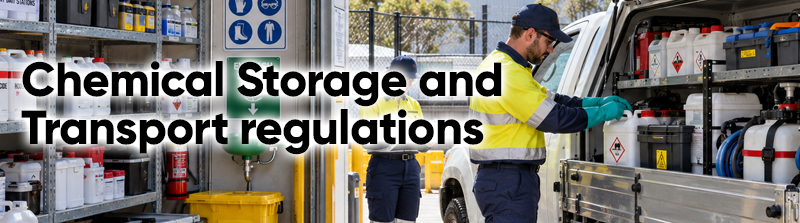
Chemical Storage and Transport regulations.
Pest controllers must follow strict federal, state, and local guidelines for storing and transporting pesticides to protect human health, safety, and the environment. These guidelines are dictated by The Australian Pesticides and Veterinary Medicines Authority (APVMA) and state bodies like the NSW Environment Protection Authority (EPA)), compliance is governed by Workplace Health and Safety laws, the Agvet Code, and training unit standards such as CPPUPM3018 (Maintain equipment and pesticide storage area in pest management vehicles).
Chemical Storage Regulations
- Storage facilities must be locked with child-resistant or restricted-access latches and clearly marked with warning or danger signage (e.g., Pesticides / Hazardous Chemicals – Keep Out).
- All pesticides must remain in their original containers with intact, legible labels. Never decant or store pesticides in food, drink, or unlabeled bottles.
- Separate pesticides from other materials. Flammable chemicals must be segregated from non-flammables (ideally by at least 3 meters), and solids should be stacked above liquids to stop the potential of leaks contaminating dry goods.
- Floors should be non-slip, impervious, and bunded to contain spills (e.g., capable of holding at least 25% of total volume or 100% of the largest package). Storage rooms must not have floor drains linked directly to storm drains or water sources.
- The area must be well-ventilated, dry, well-lit, and protected from direct sunlight and extreme temperatures.
- A fully stocked chemical spill kit, a current manifest/chemical register, and corresponding Safety Data Sheets (SDSs) must be kept close to the entrance or storage zone.
Chemical Transport Regulations
- The driver and passenger compartments of a vehicle must be completely separated from the chemical carrying or storage area by a gas-tight, air-tight barrier or bulkhead. Chemicals must never be transported inside the cabin with people.
- Enclosed vehicles or service vans carrying pesticides must feature adequate cross-flow ventilation to stop dangerous vapors or gas buildups.
- Pesticides must be stored in lockable storage cages built into or firmly secured to the vehicle chassis.
- Pest control service vehicles must be appropriately marked or labelled as required by local/state regulations.
- A spill kit suitable for the quantity of pesticides carried along with current SDS documentation must travel with the vehicle.